Sunday, November 14, 2010

"Remember Thy First Love" by Archimandrite Zacharias

Archimandrite's newly published book, Remember Thy First Love  (Revelation 2:4-5): The Three Stages of the Spiritual Life in the Theology of Elder Sophrony, is finally ready for purchase.  This is Archimandrite Zacharias' third book.  


From the Foreword, written by His Grace, Bishop BASIL, "In the book you now hold, Archimandrite Zacharias enjoins us to live in remembrance of our First Love, or in other words, to draw ever nearer to God.  He embellishes St. John's Icon [of the Ladder] with motifs from his own experience: we discern clearly for example the image of his spiritual grandfather, St. Silouan the Athonite, standing on the thirtieth and final step of the ladder, in the embrace of Chris the Rewarder of the contest.  St. Silouan in turn grasps the hand of his spiritual son Blessed Elder Sophrony of Essex, whose own arm is outstretched as he reaches towards his son, Father Zacharias, and beyond him to all of us as we attempt to make our way up the ladder."
[snip]
"He describes the first stage as a visitation of the Divine Spirit, which encourages man to conclude a covenant with God.  The second stage consists of a long and arduous struggle through God's providential withdrawal of His grace; it is during this stage that we learn the painful truth about ourselves as we are instructed in the ways of the Lord by the Holy Spirit.  The last stage involves our reacquisition - this time for all eternity - of the inalienable grace of salvation."


Saint Gregory Palamas

On November 14th, the Holy Orthodox Church commemorates St. Gregory Palamas.


The son of a prominent family, St Gregory was born (1296) and raised in Constantinople. At about age twenty, he abandoned a promising secular career to become a monk on Mt Athos. (His family joined him en masse: two of his brothers went with him to the Holy Mountain; at the same time his widowed mother, two of his sisters, and many of the household servants also entered monastic life.) He spent the next twenty years living as a hermit, spending five days a week in complete solitude, then joining the brethren on weekends for the Divine Liturgy and its accompanying services.
Around 1335 he was called to live a much more public life in defense of the faith and spirituality of the Church. A Greek living in Italy, Barlaam the Calabrian, had launched an attack on the hesychastic spirituality of the Church. Fundamentally, Barlaam denied that man can attain to a true vision of God Himself, or true union with Him, in this life. Gregory, recognizing in this an attack on the Christian faith itself, responded. He even left the Holy Mountain and re-settled in Constantinople so as better to wage the struggle, which had become so public that a Church Council was called to settle the issue. St Gregory's views were affirmed, and Barlaam's condemned, at the Council of Constantinople of 1341.
Though Barlaam himself returned to Italy, a series of his followers continued the attack, eventually resulting in two more Councils in 1347 and 1351, both of which affirmed the hesychasts' position. Metropolitan Hierotheos (
The Mind of the Orthodox Church) writes that these councils have "all the marks of an Ecumenical Council;" This, along with the fact that St Gregory's views are affirmed in the Synodikon of Orthodoxy (appointed to be read in churches every Sunday of Orthodoxy), and his commemoration every second Sunday of Great Lent, makes clear that his teaching is a basic and indispensable part of the Orthodox Faith.
In 1347 St Gregory was consecrated Metropolitan of Thessaloniki, where he served until his repose. (He spent a year of this period as the prisoner of Turkish pirates). Despite (or due to?) his austere monastic background, he was revered by his flock: immediately after his repose in 1359, popular veneration of him sprang up in Thessaloniki, Constantinople and Mt Athos and, in 1368, only nine years after his death, the Church officially glorified him as a saint.
St Gregory was always clear that unceasing mental prayer is not a special calling of monastics, but is possible and desirable for every Christian in every walk of life.

Many of his writings can be found on-line or ordered through an Orthodox supplier.


Troparion:

O light of Orthodoxy, teacher of the Church, its confirmation,
O ideal of monks and invincible champion of theologians,
O wonder working Gregory, glory of Thessalonica and preacher of grace,
always intercede before the Lord that our souls may be saved.

Kontakion:
Holy and divine instrument of wisdom,
joyful trumpet of theology,
together we sing your praises, O God-inspired Gregory.
Since you now stand before the Original Mind, guide our minds to Him, O Father,
so that we may sing to you: "Rejoice, preacher of grace."

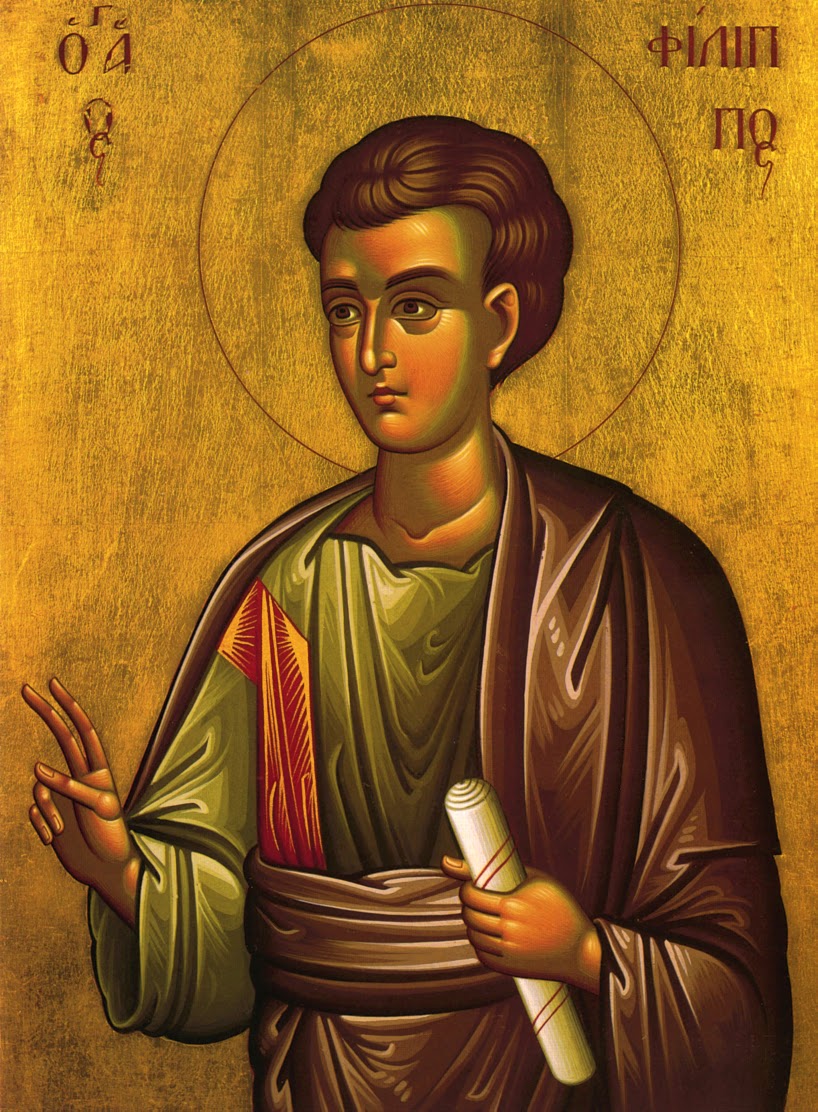
The Holy and All-lauded Apostle Philip

On November 14th, the Holy Orthodox Church commemorates the Apostle Saint Philip.

This Apostle, one of the Twelve, was from Bethsaida of Galilee, and was a compatriot of Andrew and Peter. He was instructed in the teachings of the Law, and devoted himself to the study of the prophetic books. Therefore, when the Lord Jesus called him to the dignity of apostleship, he immediately sought out and found Nathanael and said to him, "We have found Him of Whom Moses in the Law and the Prophets did write, Jesus of Nazareth, the son of Joseph" (John 1.45). Having preached Jesus the God-man throughout many parts of Asia Minor, and having suffered many things for His Name's sake, he was finally crucified upside down in Hierapolis of Phrygia.


------------------------------------------------------------------------------------


The Holy and All-praised Apostle Philip, was a native of the city of Bethsaida in Galilee. He had a profound depth of knowledge of the Holy Scripture, and rightly discerning the meaning of the Old Testament prophecies, he awaited the coming of the Messiah. Through the call of the Savior (Jn. 1:43), Philip followed Him. The Apostle Philip is spoken about several times in the Holy Gospel: he brought to Christ the Apostle Nathaniel (i.e. Bartholomew, April 22, June 30, and August 25. See Jn. 1:46). The Lord asks him where to buy bread for five thousand men (Jn. 6: 5-7). He brought certain of the Hellenized Jews wanting to see Jesus (Jn. 12:21-22); and finally, at the Last Supper he asked Christ to show them the Father (Jn. 14:8).

After the Ascension of the Lord, the Apostle Philip preached the Word of God in Galilee, accompanying his preaching with miracles. Thus, he restored to life a dead infant in the arms of its mother. From Galilee he went to Greece, and preached among the Jews that had settled there. Some of them reported the preaching of the Apostle to Jerusalem. In response, some scribes arrived in Greece from Jerusalem, with one of the Jewish chief priests at their head, to interrogate the Apostle Philip.

The Apostle Philip exposed the lie of the chief priest, who said that the disciples of Christ had stolen away and hidden the body of Christ. Philip told instead how the Pharisees had bribed the soldiers on watch, to deliberately spread this rumor. When the Jewish chief priest and his companions began to insult the Lord and lunged at the Apostle Philip, they suddenly were struck blind. By his prayer the Apostle restored everyone's sight. Seeing this miracle, many believed in Christ. The Apostle Philip provided a bishop for them, by the name of Narcissus (one of the Seventy Apostles, January 4).

From Greece the Apostle Philip went to Parthia, and then to the city of Azotus, where he healed an eye affliction of the daughter of a local resident named Nikoklides, who had received him into his home, and then baptized his whole family.

From Azotus the Apostle Philip set out to Syrian Hieropolis (there were several cities of this name) where, stirred up by the Pharisees, the Jews burned the house of Heros, who had taken in the Apostle Philip, and they wanted to kill the apostle. The apostle performed several miracles: the healing of the hand of the city official Aristarchus, withered when he attempted to strike the apostle; and restoring a dead child to life. When they saw these marvels, they repented and many accepted holy Baptism. After making Heros the bishop at Hieropolis, the Apostle Philip went on to Syria, Asia Minor, Lydia, Emessa, and everywhere preaching the Gospel and undergoing sufferings. Both he and his sister Mariamne (February 17) were pelted with stones, locked up in prison, and thrown out of villages.

Then the Apostle Philip arrived in the city of Phrygian Hieropolis, where there were many pagan temples. There was also a pagan temple where people worshiped an enormous serpent as a god. The Apostle Philip by the power of prayer killed the serpent and healed many bitten by snakes.

Among those healed was the wife of the city governor, Amphipatos. Having learned that his wife had accepted Christianity, the governor Amphipatos gave orders to arrest St. Philip, his sister, and the Apostle Bartholomew travelling with them. At the urging of the pagan priests of the temple of the serpent, Amphipatos ordered the holy Apostles Philip and Bartholomew to be crucified.

Suddenly, an earthquake struck, and it knocked down all those present at the place of judgement. Hanging upon the cross by the pagan temple of the serpent, the Apostle Philip prayed for those who had crucified him, asking God to save them from the ravages of the earthquake. Seeing this happen, the people believed in Christ and began to demand that the apostles be taken down from the crosses. The Apostle Bartholomew was still alive when he was taken down, and he baptized all those believing and established a bishop for them.

But the Apostle Philip, through whose prayers everyone remained alive, except for Amphipatos and the pagan priests, died on the cross.

Mariamne his sister buried his body, and went with the Apostle Bartholomew to preach in Armenia, where the Apostle Bartholomew was crucified (June 11); Mariamne herself then preached until her own death at Lykaonia.


Apolytikion:
O Holy Apostle Philip, intercede with the merciful God that He grant unto our souls forgiveness of offences.


Kontakion:
Your disciple and friend, emulator of Your passion, the divinely eloquent Philip, proclaimed You to the world as God. By his entreaties, and through the Theotokos, keep Your Church from lawless enemies, O most merciful.


Saint John Chrysostom

On November 13th, the Holy Orthodox Church commemorates one of the Three Holy Hierarchs, that is, St. John Chrysostom.


This greatest and most beloved of all Christian orators was born in Antioch the Great in the year 344 or 347; his pious parents were called Secundus and Anthusa. After his mother was widowed at the age of twenty, she devoted herself to bringing up John and his elder sister in the nurture and admonition of the Lord. John received his literary training under Anthragathius the philosopher, and Libanius the sophist, who was the greatest Greek scholar and rhetorician of his day. Libanius was a pagan, and when asked before his death whom he wished to have for his successor, he said, "John, had not the Christians stolen him from us." With such a training, and with such gifts as he had by nature, John had before him a brilliant career as a rhetorician. But through the good example of his godly mother Anthusa and of the holy Bishop Meletius of Antioch (see Feb. 12), by whom he was ordained reader about the year 370, he chose instead to dedicate himself to God. From the years 374 to 381 he lived the monastic life in the hermitages that were near Antioch. His extreme asceticism undermined his health, compelling him to return to Antioch, where Saint Meletius ordained him deacon about the year 381. Saint Meletius was called to Constantinople later that year to preside over the Second Ecumenical Council, during which he fell asleep in the Lord. In 386 Bishop Flavian ordained John presbyter of the Church of Antioch. Upon his elevation to the priesthood his career as a public preacher began, and his exceptional oratorical gifts were made manifest through his many sermons and commentaries. They are distinguished by their eloquence and the remarkable ease with which rich imagery and scriptural allusions are multiplied; by their depth of insight into the meaning of Scripture and the workings of God's providence; and, not least of all, by their earnestness and moral force, which issue from the heart of a blameless and guileless man who lived first what he preached to others. Because of his fame, he was chosen to succeed Saint Nectarius as Patriarch of Constantinople. He was taken away by stealth, to avoid the opposition of the people, and consecrated Patriarch of Constantinople on February 28, 398, by Theophilus, Patriarch of Alexandria, who was to prove his mortal enemy.

At that time the Emperor of the East was Arcadius, who had had Saint Arsenius the Great as his tutor (see May 8); Arcadius was a man of weak character, and much under the influence of his wife Eudoxia. The zealous and upright Chrysostom's unsparing censures of the lax morals in the imperial city stung the vain Eudoxia; through Theophilus' plottings and her collaboration, Saint John was banished to Pontus in 403. The people were in an uproar, and the following night an earthquake shook the city; this so frightened the Empress Eudoxia that she begged Arcadius to call Chrysostom back. While his return was triumphant, his reconciliation with the Empress did not last long. When she had a silver statue of herself erected in the forum before the Church of the Holy Wisdom (Saint Sophia) in September of 403, and had it dedicated with much unseemly revelry, Saint John thundered against her, and she could not forgive him. In June of 404 he was exiled to Cucusus, on the borders of Cilicia and Armenia. From here he exchanged letters with Pope Innocent of Rome, who sent bishops and priests to Constantinople requesting that a council be held. Saint John's enemies, dreading his return, prevailed upon the Emperor to see an insult in this, and had John taken to a more remote place of banishment called Pityus near the Caucasus. The journey was filled with bitter sufferings for the aged bishop, both because of the harshness of the elements and the cruelty of one of his 310 guards. He did not reach Pityus, but gave up his soul to the Lord near Comana in Pontus, at the chapel of the Martyr Basiliscus (see May 22), who had appeared to him shortly before, foretelling the day of his death, which came to pass on September 14, 407. His last words were "Glory be to God for all things." His holy relics were brought from Comana to Constantinople thirty-one years later by the Emperor Theodosius the Younger and Saint Pulcheria his sister, the children of Arcadius and Eudoxia, with fervent supplications that the sin of their parents against him be forgiven; this return of his holy relics is celebrated on January 27.

Saint John was surnamed Chrysostom ("Golden-mouth") because of his eloquence. He made exhaustive commentaries on the divine Scriptures and was the author of more works than any other Church Father, leaving us complete commentaries on the Book of Genesis, the Gospels of Saints Matthew and John, the Acts, and all the Epistles of Saint Paul. His extant works are 1,447 sermons and 240 epistles. Twenty-two teachers of the Church have written homilies of praise in his honour. Besides his feasts today and on January 27, he is celebrated as one of the Three Hierarchs on January 30, together with Saint Basil the Great and Saint Gregory the Theologian.
(It should be noted that, because September 14 is the Exaltation of the Cross, the Saint's memory has been transferred to this day.)


Apolytikion:
The grace of your words illuminated the universe like a shining beacon. It amassed treasures of munificence in the world. It demonstrated the greatness of humility, teaching us by your own words; therefore, O Father John Chrysostom, intercede to Christ the Logos for the salvation of our souls.

Kontakion:
You received divine grace from Heaven, and by your own lips taught all to worship the One God in Trinity. All-blessed, venerable John Chrysostom, deservedly, we praise you for you are a teacher clearly revealing things divine.


Saint John the Almsgiver

On November 12, the Holy Orthodox Church commemorates St. John the Almsgiver (Merciful), Patriarch of Alexandria.

Saint John was born in 555 on the island of Cyprus in the city of Amathus; his father, Epiphanius, was a ruler of Cyprus. The Saint was consecrated Archbishop of Alexandria in 608. A man of exemplary uprightness, in his zeal for Orthodoxy he strove mightily to fight the many heresies among the Christians in Egypt; but above all, he was famous for his singular generosity, humility, and sympathy towards all, especially the poor. His mercy was so great that the report of it reached the Persian invaders of Jerusalem, who desired to see him because of it. Saint John reposed in 619, at the age of sixty-four.


Apolytikion:
In patiently enduring, you obtained your reward, O venerable father. You persevered in your prayers without ceasing; and you loved the impoverished and you satisfied them. We entreat you, intercede with Christ God, O blessed John the Merciful, for the salvation of our souls.

Kontakion:
Thy riches and wealth didst thou disperse unto the poor; thou now hast received the Heavens' riches in return. For this cause, O all-wise John, we all honour thee with our songs of praise as we keep thy memorial, O namesake of almsgiving and of mercy.

Saint Nectarios the Wonderworker

On November 9th, the Holy Orthodox Church commemorates Saint Nectarios/Nektarios the Wonderworker, Metropolitan of Pentapolis.


Saint Nectarius was born in Selyvria of Thrace on October 1, 1846. After putting himself through school in Constantinople with much hard labour, he became a monk on Chios in 1876, receiving the monastic name of Lazarus; because of his virtue, a year later he was ordained deacon, receiving the new name of Nectarius. Under the patronage of Patriarch Sophronius of Alexandria, Nectarius went to Athens to study in 1882; completing his theological studies in 1885, he went to Alexandria, where Patriarch Sophronius ordained him priest on March 23, 1886 in the Cathedral of Saint Sabbas, and in August of the same year, in the Church of Saint Nicholas in Cairo, made him Archimandrite. Archimandrite Nectarius showed much zeal both for preaching the word of God, and for the beauty of God's house. He greatly beautified the Church of Saint Nicholas in Cairo, and years later, when Nectarius was in Athens, Saint Nicholas appeared to him in a dream, embracing him and telling him he was going to exalt him very high.

On January 15, 1889, in the same Church of Saint Nicholas, Nectarius was consecrated Metropolitan of the Pentapolis in eastern Libya, which was under the jurisdiction of Alexandria. Although Nectarius' swift ascent through the degrees of ecclesiastical office did not affect his modesty and childlike innocence, it aroused the envy of lesser men, who convinced the elderly Sophronius that Nectarius had it in his heart to become Patriarch. Since the people loved Nectarius, the Patriarch was troubled by the slanders. On May 3, 1890, Sophronius relieved Metropolitan Nectarius of his duties; in July of the same year, he commanded Nectarius to leave Egypt.

Without seeking to avenge or even to defend himself, the innocent Metropolitan left for Athens, where he found that accusations of immorality had arrived before him. Because his good name had been soiled, he was unable to find a position worthy of a bishop, and in February of 1891 accepted the position of provincial preacher in Euboia; then, in 1894, he was appointed dean of the Rizarios Ecclesiastical School in Athens. Through his eloquent sermons his unwearying labours to educate fitting men for the priesthood, his generous alms deeds despite his own poverty, and the holiness, meekness, and fatherly love that were manifest in him, he became a shining light and a spiritual guide to many. At the request of certain pious women, in 1904 he began the building of his convent of the Holy Trinity on the island of Aegina while yet dean of the Rizarios School; finding later that his presence there was needed, he took up his residence on Aegina in 1908, where he spent the last years of his life, devoting himself to the direction of his convent and to very intense prayer; he was sometimes seen lifted above the ground while rapt in prayer. He became the protector of all Aegina, through his prayers delivering the island from drought, healing the sick, and casting out demons. Here also he endured wicked slanders with singular patience, forgiving his false accusers and not seeking to avenge himself. Although he had already worked wonders in life, an innumerable multitude of miracles have been wrought after his repose in 1920 through his holy relics, which for many years remained incorrupt. There is hardly a malady that has not been cured through his prayers; but Saint Nectarius is especially renowned for his healings of cancer for sufferers in all parts of the world.


Apolytikion:
O faithful, let us honor Nectarios, divine servant of Christ, offspring of Silivria and guardian of Aegina, who in these latter years was manifested as the true friend of virtue. All manner of healing wells forth for those who in piety cry out, "Glory to Christ who glorified you; glory to Him who, through you, wrought wonders; glory to Him who, through you, works healing for all."

Kontakion:
In joy, let our hearts praise the latest shining star of the Orthodox, the newly erected rampart of the Church. For, glorified by the work of the Spirit, he abundantly pours forth the grace of healing to those who cry out, "Hail, Father Nectarios".

Monday, November 8, 2010

Synaxis of the Archangels and Bodiless Powers of Heaven

Today, November 8th, is the Feast of the Synaxis of the Archangels and Bodiless Powers of Heaven! 

All the Angels, according to the Apostle Paul, are ministering spirits, - sent forth to minister to them who shall be heirs of salvation - (Heb. 1:14). God set them as overseers of every nation and people, and guides to that which is profitable (Deut. 32:8); and while one Angel is appointed to oversee each nation as a whole, one is also appointed to protect each Christian individually. He commands them to guard them that hope on Him, that nothing should harm them, neither should any evil draw nigh to their dwelling (Ps. 90:10-12). In the Heavens they always behold the face of God, sending up to Him the thrice-holy hymn and interceding with Him in our behalf, seeing they rejoice over one sinner that repents (Esaias 6:2-3; Matt. 18:10; Luke 15:7). In a word, they have served God in so many ways for our benefit, that the pages of Holy Scripture are filled with the histories thereof. It is for these reasons that the Orthodox Catholic Church, wisely honouring these divine ministers, our protectors and guardians, celebrates today the present Synaxis that is, our coming together in assembly for their common feast to chant their praises, especially for the Archangels Michael and Gabriel, who are mentioned in the Scriptures by name. The name Michael means "Who is like God?" and Gabriel means "God is mighty." The number of Angels is not defined in the divine Scriptures, where Daniel says that thousands of thousands ministered before Him, and ten thousands of ten thousands attended upon Him -(Dan. 7:10). But all of them are divided into nine orders which are called Thrones, Cherubim, Seraphim, Dominions, Powers, Authorities, Principalities, Archangels, and Angels.

St. Dionysius the Areopagite wrote a book called "Celestial Hierarchy"  


Apolytikion:
O Commanders of the Heavenly Host, we the unworthy beseech you, that through your entreaties you will fortify us, guarding us in the shelter of the wings of your ethereal glory, even as we fervently bow before you crying: "Deliver us from all danger, as Commanders of the Powers on high! 

Kontakion:
Chief Commanders of God; ministers of divine glory; guides for men and leadership of the Incorporeal; as Chief Commanders of the Incorporeal, plead for our welfare and for great mercy.

About Me

My photo
Northwest Arkansas, Arkansas, United States
My name is Ignatios Jason Rogers and I was received into the Holy Antiochian Orthodox Church at St. Nicholas in Springdale, AR on Christmas Eve of 2006. I am currently seeking the monastic path and hopefully one day will be able to enter a monastery.

Followers